
Low Transport Fever 3 citizen happiness means that residents’ travel needs are not being met consistently. The fastest way to improve it is to open the affected town’s ratings, use the passenger satisfaction layer to find weak network sections, and inspect individual residents to determine whether they are waiting too long or spending too much time travelling.
Do not respond to every low happiness warning by immediately adding more vehicles. Extra capacity can improve throughput when passengers are stranded, but it can also leave vehicles trapped in the same congestion or create additional queues elsewhere. Diagnose the failing trip first, then choose between more throughput, greater comfort, a shorter journey, or removal of an operational bottleneck.
Understand what citizen happiness measures
Citizen happiness is the passenger-focused part of the town rating system. It reflects how well residents’ travel needs are served, including time spent waiting at stations and time spent travelling. The passenger satisfaction layer visualizes satisfaction across the transport network, while an individual resident’s details can reveal what happened during that person’s journey.
Citizen happiness is not a combined score for every town problem. Keep these related measurements separate:
| Rating or system | What it represents | Why the distinction matters |
|---|---|---|
| Happiness | Residents’ passenger journeys, including waiting and travel time | This is the rating you are diagnosing on this page |
| Reputation | Treatment of the town and surrounding nature | A reputation problem is not proof that passenger service is poor |
| Delivery | Whether cargo reaches its destination on time | Late freight does not directly identify an unhappy passenger trip |
| Traffic | How smoothly road traffic flows | Congestion can delay passenger vehicles, but traffic remains its own rating |
| Noise | Noise affecting residential areas | Noise can reduce the town’s broader performance without being the same statistic as happiness |
| Pollution | Pollution across the town area | Pollution is another municipal rating, even when the same vehicles contribute to it |
The overall Town Authority rating is determined by the lowest of its six ratings. Therefore, raising happiness has the greatest immediate value when happiness is the town’s weakest rating. A town can still be constrained by traffic, noise, pollution, delivery, or reputation after passenger satisfaction improves.
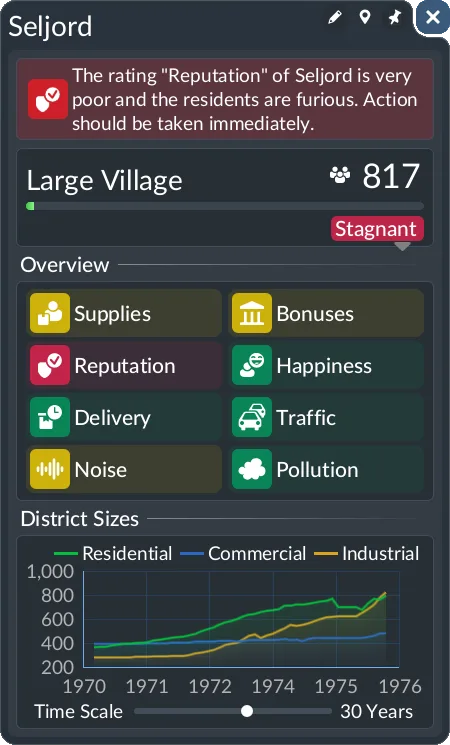
Happiness is a separate rating; a different town problem can be the weakest growth factor.
Find the failing trip before changing the network
Start with evidence from the town and its passengers. The goal is to move from a town-wide warning to a specific line, station, vehicle, or journey that can be changed.
1. Confirm that happiness is the limiting rating
Open the town window and review all of its ratings. If happiness is already stronger than another rating, improving it may not raise the overall authority rating immediately. You can still repair a poor passenger experience, but do not mistake that work for a guaranteed solution to every town-growth problem.
If happiness is the weakest rating, continue with the passenger satisfaction tools. Avoid using the delivery or cargo satisfaction view as a substitute; those views diagnose different trips and different penalties.
2. Open the passenger satisfaction layer
The passenger satisfaction layer colors sections of the transport network according to passenger satisfaction. Redder sections indicate lower satisfaction, while greener sections indicate higher satisfaction. Labels above vehicles summarize satisfaction for those vehicles, helping you narrow the search without opening every line individually.
Scan the affected town and its approaches rather than looking only at the town center. A resident’s bad journey may begin at an outer residential stop, continue through a transfer point, and become visible on a vehicle serving another district. Look for clusters of poor sections and low-satisfaction vehicle labels. A single isolated weak section suggests a localized problem; several connected weak sections suggest that the journey is failing across more than one stage.
3. Inspect the station and nearby passenger load
After identifying a weak section, inspect the stations used by that service. A visibly overcrowded station is a strong sign that the line is not moving passengers through quickly enough. Determine whether people are accumulating at one stop, at both ends, or at a transfer point.
That location matters. A queue at one stop can point to uneven demand or a local delay. Crowding across several stops is more consistent with insufficient effective throughput along the line. A transfer point can also expose a timing mismatch: passengers reach the interchange, but the next service does not remove them quickly enough.
Do not treat the visible crowd as the entire diagnosis. Passengers may also be unhappy because the journey itself takes too long, even if the platform is not currently full.
4. Check an individual resident’s travel history
Open an individual resident from the affected area or passenger group and review the available journey details. The resident’s travel history can show that the person waited longer than expected. Residential building details also provide a list of residents with their current happiness and action, which helps you find people currently making or attempting relevant trips.
Use several residents from the same problem area when possible. One journey can identify a failure, but repeated complaints associated with the same stop, line, or segment give you a stronger basis for changing the network. The useful question is not simply whether a citizen is unhappy; it is where that citizen lost time.
Match the fix to the passenger problem
Once you know where the journey deteriorates, apply the smallest change that addresses that cause. Recheck the same residents, stations, vehicles, and network sections afterward.
Increase effective throughput for stranded passengers
When passengers accumulate because the line cannot move them quickly enough, increasing throughput is appropriate. Adding vehicles is one available response, but only when the route and its stops can absorb the additional service.
Before expanding the fleet, check the full movement path. If vehicles are already delayed in traffic or waiting behind one another, another vehicle may join the delay instead of clearing the queue. In that situation, effective throughput will not increase in proportion to fleet size.
When the path is moving normally and vehicles are leaving full, additional service can help reduce the number of stranded passengers. Watch the queue after the change. The important result is a sustained reduction in waiting passengers, not merely a higher vehicle count.
Improve comfort when some waiting is unavoidable
Higher-comfort stations or vehicles increase passengers’ patience for wait times. This makes comfort a useful response when a line cannot eliminate every wait but otherwise provides a workable service.
Comfort should not be treated as a replacement for capacity. A more comfortable vehicle does not clear an overcrowded platform if it carries too few people or arrives too infrequently. Likewise, a station upgrade should not conceal a line that is stalled elsewhere. Use comfort to make a reasonable wait more tolerable, not to excuse a network that cannot transport its passengers.
There is no supported universal wait-time number that comfort guarantees. Judge the result through the satisfaction layer, vehicle summaries, resident details, and the station queue after the upgraded service has operated.
Reduce excessive time spent travelling
Happiness also accounts for time spent on the journey. A line can avoid visible overcrowding and still produce poor satisfaction if passengers spend too long travelling.
Trace the low-satisfaction sections in sequence and watch for places where passenger vehicles lose time. Road traffic can slow buses or other road-based public transport. A long delay on the approach to a station can then cause both a slow onboard journey and a longer wait for the passengers at the next stop.
Choose changes that reduce the actual delay affecting the passenger service. The correct action depends on the observed location: the vehicle path may need to avoid a bottleneck, the service may need more usable capacity, or the network may need a less obstructed passenger connection. Verify that the changed journey becomes faster instead of assuming that a visually shorter route is operationally better.
Restore service degraded by vehicle condition
Vehicles are maintained automatically only while operating within range of an appropriate facility. Neglected vehicles gradually slow down and produce more noise and pollution.
A slowing passenger vehicle can indirectly harm happiness by increasing travel time and disrupting service frequency. Check maintenance coverage when a previously adequate line becomes slower without an obvious demand increase. This is a supporting check, not a reason to turn the happiness diagnosis into a full maintenance rebuild.
Account for traffic, noise, and pollution without mixing the ratings
Passenger lines operate inside a municipal system, so one network decision can influence several ratings. Keep the causal chain clear when evaluating a change.
Residential areas are specifically sensitive to noise, while commercial and industrial districts are not negatively influenced by noise in the same way. This can affect where a route creates municipal side effects, but it does not change the definition of citizen happiness. Use the noise and pollution breakdowns or their corresponding layers when those ratings are weak; do not infer them solely from a red passenger section.
Verify that citizen happiness has recovered
A successful fix should be visible at more than one level. Use this completion checklist:
- The previously weak network sections move away from the lowest-satisfaction coloring.
- Vehicle satisfaction summaries improve on the affected service.
- Passenger accumulation at the problem station decreases and stays manageable.
- Newly inspected residents no longer show the same repeated waiting or travel-time problem.
- Vehicles complete the line without the original recurring delay.
- Happiness improves in the town ratings.
- Another Town Authority component has not become the new limiting rating without being noticed.
The last check prevents a common misreading. Fixing citizen happiness can reveal that traffic, noise, pollution, delivery, or reputation is now the town’s weakest rating. That does not mean the passenger fix failed. It means the happiness bottleneck was removed and the town now exposes a different constraint.